
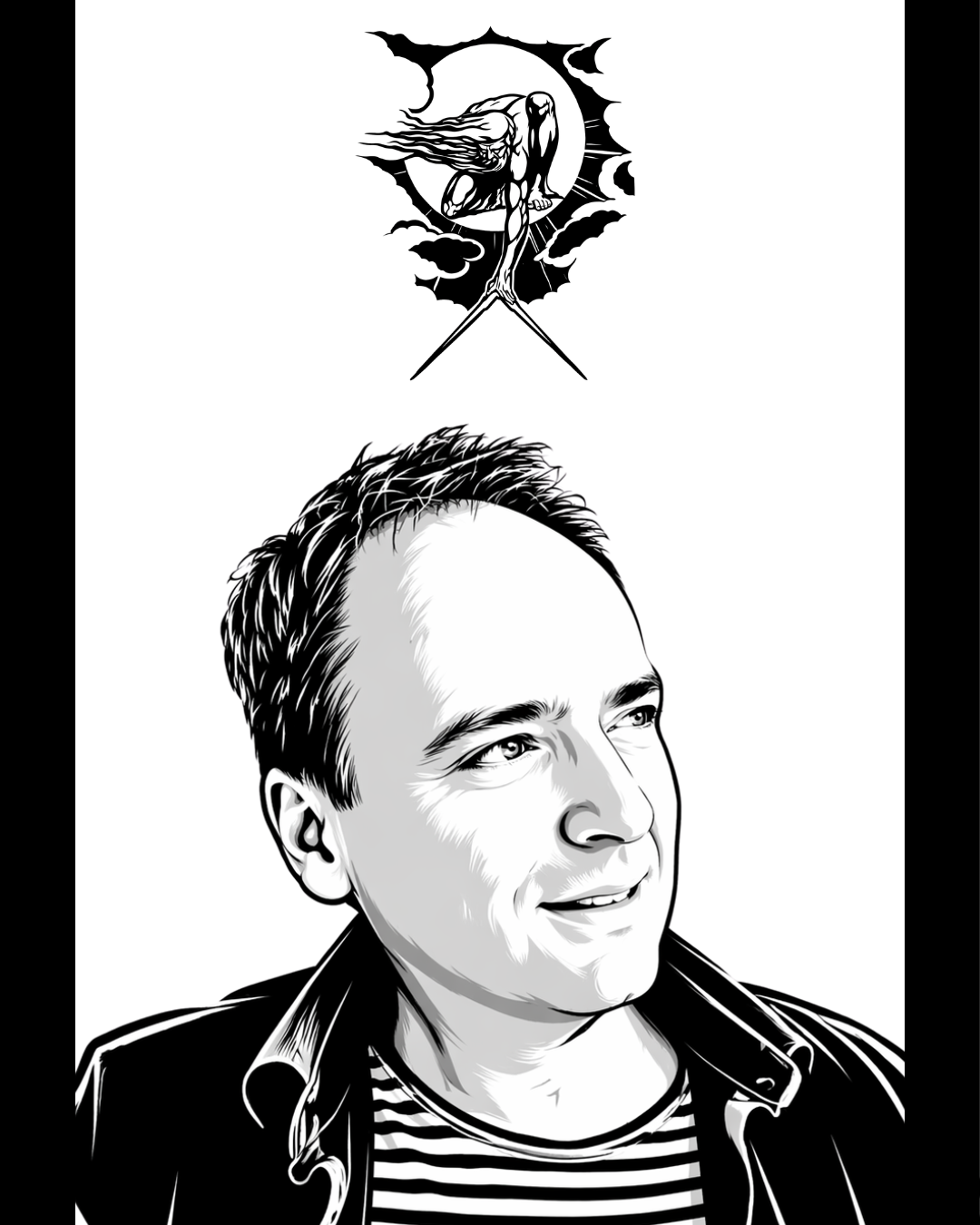
Conversation with a Temenos Fellow & Institution founder
While our conversation with the Nicholas Roerich museum revealed how a polymathic mind can animate a museum—bringing culture, inner life, and civic meaning into living relation—Dr. Valentin Gerlier carves another path.
A Temenos Academy Fellow and founder of the School of Sophia, Valentin Gerlier teaches poetry not as literary decoration or mere performance, but as a profound and practical discipline of attention, insight, and transcendence.
In his powerful pedagogy, poetry is enacted through language, nature, the body, myth, and philosophy. This integrative approach proposes something radical: a way of teaching and learning in which fragmentation is no longer the default.
This is the Non-Dual Gaze at work in education.

You lead the Poetics of Imagination programme at Schumacher College. Could you describe what ‘poetics of imagination’ means— from an academic perspective and as a lived practice?
The programme explores how the wellspring we now call ‘imagination’ expresses itself — its ‘poetics’ — at the most fundamental levels of our culture, particularly through language. We read, study, tell and perform myth, stories, dramas, poetry and a range of philosophy to explore this.
Imagination is the deep underground source—the boundless ocean from which every river of expression flows, like rain that brings goodness to the soil of our culture. It speaks through myth, metaphor, symbol, voice, phrase and poetry before it can become itemized, quantified and controlled into prose, technical language, political rhetoric and even everyday communication.
Our late-modern global culture imaginary operates under the illusion that only what is quantifiable or open to methodological analysis is real. It therefore tends to dismiss imagination as mere fancy or wish-fulfillment, an escape from the quantifiable real into the vapor-like fabulous.
But the opposite is true: an encounter with the imagination actually deepens our understanding of reality. In a student-teacher dynamic, it even reveals how the strictest methodology is itself founded on symbolic expression. The history of western science is particularly telling to that extent!
Our course leads students back to this ability to tend to and attend to the imagination — with all its promises and perils, its wellsprings and dangers — and helps them sense the difference between genuine imagination and distracted fantasy.
In terms of lived practice, it means walking a middle path between receptivity—deep attention—and creativity, the latter born from the marriage of rigor and wildness. So we encourage the development of open, attentive listening as well as the unfolding of poetic creativity and poetic discipline.
Such lived practice encourages and sharpens our sense of a universe bound together through poetic affinity. Human language is at root symbolic and mythic because it is intimately entangled with what lies forever beyond words — not as the obstacle to poetic expression, but as its very source. Returning to a living relationship with this source is both an intellectual study and a daily practice. In my view, it is essential if we are to bring about creative change in the world.

Genuine beauty, like transformation, […] must come of its own accord, through renewed practice and a certain form of waiting without expectation.
VALENTIN GERLIER
I was struck by the ‘Wisdom and Water’ module description: students speaking poetry aloud while walking, embodying verse through gesture, and co-creating imaginary paintings through speech. Why is embodiment so central to your teaching?
The relationship between language and the body is one we are now in danger of losing today. Particularly in this age, where language is increasingly disembodied — churned out by ‘chatbots’ whose speech patterns are predictive rather than poetic, and who mimic but cannot sense the promissory, prayerful and mythopoetic dimensions of speech, — it is essential to return poetic language to the body, the senses and the voice, rather than leaving it trapped on the page or screen.
I am not against these things; they have their rightful place. But they only serve us when our attention is grounded in intelligent, embodied practice and can discern the difference.
For words to truly matter, they must touch the material word. Imagination binds soul and body together. As such, it must ‘enter’ our physical expression in unpredictable and intimate ways. The soul must learn to listen to the body, just as the body must listen to the soul.
Because words are primordially symbolic and poetic, they are deeply linked to storytelling, performance, movement, gesture, and stillness. They cannot be fully abstracted from these living dimensions. The written page is important, but it should never be confused with the unique, lived, and eternal moment of genuine expression.
Your scholarship spans Shakespeare, Blake, Dante, Rilke, and the Western contemplative tradition. What draws you to these figures?
Good question! All these figures offer profound poetic and artistic responses to the malaise of their time. They are deeply alive and are alive and sensitive to the difficulties and disorders of their age, and they seek to diagnose — and perhaps even heal them — at the level of the drama and poetry.
For me, the contemplative tradition is the other half of this same movement. The poets reveal the deep poetic, philosophical and spiritual affinities between things. Through imagination, they orient us toward a vision of reality that allows us to see properly and potentially, bring about a transformative movement.
As both Shakespeare and Blake saw, to see properly is to see “double”: with the physical eye, but also through it, with the spiritual eye.
The contemplative gesture, in turn, grounds all vision in the eye of God itself. It points towards a rigorous, discerning, quiet and loving attention — a movement toward the ground of all being.
One breathes out, the other breathes in.
One sings, the other listens to the eternal music from which all songs come!
The polymath tradition — figures who moved fluidly between art, science, philosophy, and inquiry into self-knowledge — has largely disappeared from contemporary culture. Do you see signs of its return? And what role does poetry & myth play in that return?
There are some promising inklings of such a return. Academia and public discourse pay lip-service to collaborative forms of “interdisciplinarity,”; yet in practice, they still insist that knowers should “stay in their lane,” remaining hyper-specialists in narrowly defined fields whose boundaries are carefully policed.
To me, the polymath tradition bears witness to something deeper: the intuition that what is most true lies at the level of a universal common ground — a shared reality that glimmers in and through the receptive and creative powers of the human soul. It is a common creative ground, necessarily universal, and out of which flow many disciplines, which hallows and blesses difference while gathering all of us into unity.
The great polymaths drew their inspiration from a living relationship with this ever-present source —the ground of being itself. It was their devotion and orientation towards this common creative ground, rather than any pursuit of lone or unusual “genius” that allowed them to shine with such astonishing brilliance and insight across many fields.
Nicholas Roerich believed that art could be a vehicle for inner transformation, and advocated for the beautification of our spaces as a deliberate connection and presentification of the Divine. How does that resonate with your own understanding of the relationship between aesthetic experience and contemplative practice?
Beauty orients us to the ground of being, toward the Divine itself. It acts as its intermediary, its friend and messenger. The soul is made beautiful through this longing for the divine other.
I express this in these passionate terms, yet there is a very simple, everyday, practical dimension to it. The work of the soul is indeed work. It asks for renewed humility, dedication, rigorous practice—and a sense of humour!
Genuine beauty, like transformation, comes about unpredictably, uncontrolled—it must come of its own accord, through renewed practice and a certain form of waiting without expectation. This contemplative practice teaches! It teaches hospitality to the beautiful unknown.
The Polymath Evenings at the Roerich Museum NEW YORK x Revue R are built on the premise that genuine dialogue between disciplines requires a container—silence, intimacy, mutual respect. What conditions have you found necessary for that kind of dialogue to occur?
Such dialogue is possible if certain practices of honest self-understanding are already at work in the participants. It also helps to hold these outside of conventional institutions, where professional expectations, fear for one’s position, and competitive habits can be kept at bay.
Most importantly, a convivial atmosphere is essential, where beauty and friendship can be sensed in the room among the participants themselves. Dialogue should never be isolated from the rest of life. Good food, good music, laughter—these things are equally important.
What’s next for you, and is there a question I should have asked but didn’t?
I am currently working on my next book Heaven’s Wildflowers: A Blakean Theory of Nature, Culture and Imagination for Routledge, a book on the ontological, ecological and spiritually regenerative power of the imagination.
I’ve also started School of Sophia, a little hybrid wisdom school, which I hope will thrive in the times to come.
« IMAGINATION IS THE MIDDLE VOICE OF THE UNIVERSE»
WHAT IS BEAUTY?
“Ask yourself, enquire very deeply what is this word used by poets, painters, and sculptors, and you are asking yourself now, what is this quality of beauty. Do you want me to answer it or will you?”
Jiddu Krishnamurti cuts through the fog.

THE NON-DUAL GAZE
A new issue, many returns
Enter Revue R’s essential conversations with museum curators and art educators where creativity, philosophy, and the inner life meet again to beautify our lives.

Leave a Reply