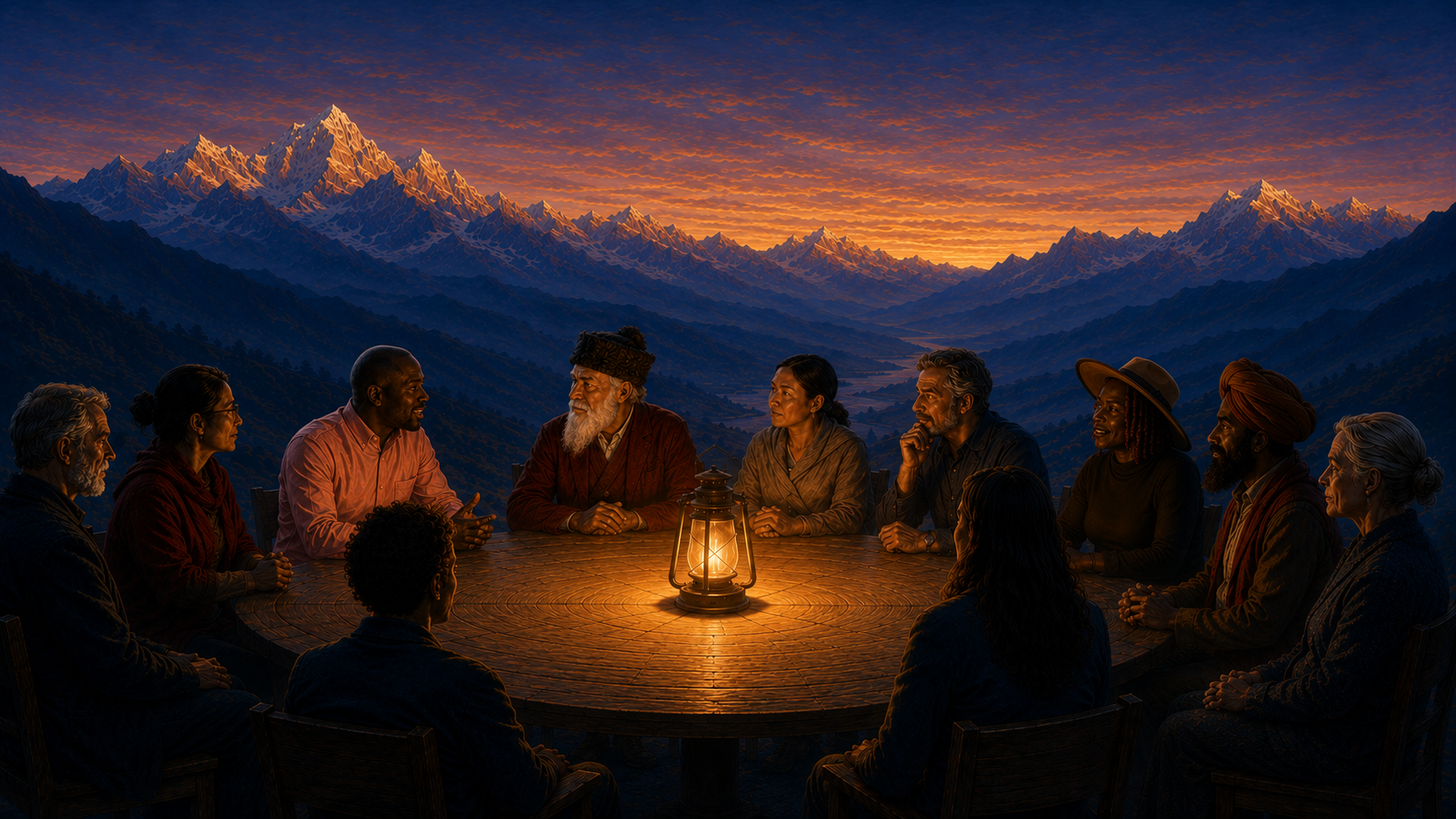
Polymath Evenings is a series of public conversations conceived and hosted by Revue Révolution, bringing scientists, poets, philosophers and artists into dialogue across disciplines, cultures & geographies.
Their purpose is to cultivate a living culture of peers in poetry and art, inspired by the collaborative culture of science — rigorous, generous, rooted in craft and history, unafraid of beauty, and built through the exchange of knowledge across generations.
Each edition orbits a single question.
The first asks: Where does creativity come from?
Each participant to the Polymath Evenings brings a distinct mode of inquiry to the conversation.
Meet the Polymath Circle Opus I.
Murielle Mobengo | Revue Révolution | New York
Poet · Painter · Cultural Strategist
Murielle Mobengo is a poet, painter, and cultural strategist whose work traces the correspondences between art, philosophy, myth, and inner life across European, Asian, and African traditions.
As Editor-in-Chief of Revue Révolution and through its institutional practice, L’Atelier Révolution, she turns that sensibility into editorial projects, exhibition narratives, and public programs for cultural institutions.
She understands this work as a form of cultural diplomacy: creating the conditions for different traditions, disciplines, and generations to meet.
Murielle Mobengo is the founder and convener of the Polymath Circle and the Polymath Evenings — her contribution toward a living culture of peers in art and poetry, inspired by the collaborative culture of science.
Loïc Yengo | University of Queensland | Brisbane, Australia
Mathematician · Geneticist · Musician
Loïc Yengo is a mathematician and geneticist who leads the Statistical Genomics Laboratory at the University of Queensland, developing new statistical methods to map the genetic architecture of human diversity and the biology of complex traits and disease.
His discoveries in this field, published in Nature, have been recognized by the Australian Academy of Science’s Gani Medal and a Snow Fellowship.
A musician as well as a scientist, Yengo brings to research a lasting curiosity about perception, experience, and abstraction — and about emergence: the possibility that connecting ideas and forms of knowledge can reveal what none of them makes visible alone.
The Polymath Evenings owe part of their spark to a decade of conversation between Loïc and the project’s founder — his sister — on knowledge, experience, polymathy, and the inner life.
Sourav Sengupta | Independent / Revue Révolution | Bangalore, India
Poet · Erudite
Sourav Sengupta is an Indian poet and erudite who draws on Indian and Western poetic traditions, history, and his training as an architect, approaching poetry as both a creative practice and a form of knowledge attentive to metre and musicality.
His poem Aśoka at Dhauli, written in ballad metre, gives voice to the emperor’s transformation after the Kalinga War — a turning point in the history of human conscience. Grounded in rigorous historical exegesis, it shows that verse can carry the full epistemic weight of an ethical and historical account — recalling the classical Indian tradition in which even mathematics was composed in verse.
At the center of his thinking is a map of the arts by their levels of abstraction — from architecture, through sculpture and painting, to poetry, where the word alone must summon what the other arts can show, touch, or inhabit. Because poetry gives the mind least and asks of it most, he argues, it is the most demanding craft of all — which makes the proper training of poets a pressing question, and one from which everything else follows: how their work is supported, and whether it is held to real standards of form and knowledge.
His 2023 conversation with Revue Révolution — ranging from the Baul singers of Bengal to the origins of creativity, from the meeting of East and West to the inner life of the poem — already held, in seed, nearly every question the Polymath Evenings would later gather around. It is where the project first began to take shape.
David Capps | Southern Connecticut State University | New Haven
Philosopher · Poet · Musician · Chess player
David Capps is an American philosopher, poet, and musician whose work moves between philosophical inquiry, literary form, and lived experience, drawn to perception, creativity, and ethics.
A violinist and longtime journaler, he treats philosophy as a practice in correspondence with other forms of experience — reading musical structure alongside writing, and myth alongside argument. In Silence Divine, published in Revue Révolution’s 2024 issue Ô, Sound Divine, he considers silence not as the mere absence of sound, but as the condition from which imagination, insight, and genuine dialogue arise.
At the center of his work is contemplation and unstructured attention — a sustained attentive state through which familiar assumptions fall away, and an idea, an experience, or a work of art can be met on its own terms.
His conversation with Revue Révolution on silence helped shape the spirit of the Polymath Evenings.
Valentin Gerlier | School of Sophia / Temenos Academy | London, UK
Philosopher · Poet · Musician · Institution Founder
Valentin Gerlier is a philosopher, poet, and musician whose work explores the meeting of literature, philosophy, the inner life, and imagination, engaging particularly with Shakespeare, William Blake, myth, and the perennial traditions of thought.
A Fellow and Tutor of the Temenos Academy in London, he is the founder of the School of Sophia, a contemporary wisdom school inspired by ancient models of learning and grounded in contemplation, study, dialogue, enactment, and collective inquiry. He previously led the Poetics of Imagination programme at Schumacher College, bringing poetry, myth, story, philosophy, and inner inquiry into a shared field of study.
At the center of his work is imagination — not fancy or ornament, but a fundamental way of discovering truth, the faculty through which what is real first becomes visible.
In his 2026 conversation with Revue Révolution, “We need a creative common ground,” Gerlier named the very work the Polymath Evenings exist to do — bringing back into living relation the forms of knowledge that modern culture has held apart.
POLYMATH EVENING
→ Discover the Polymath
Portrait
Conversations


