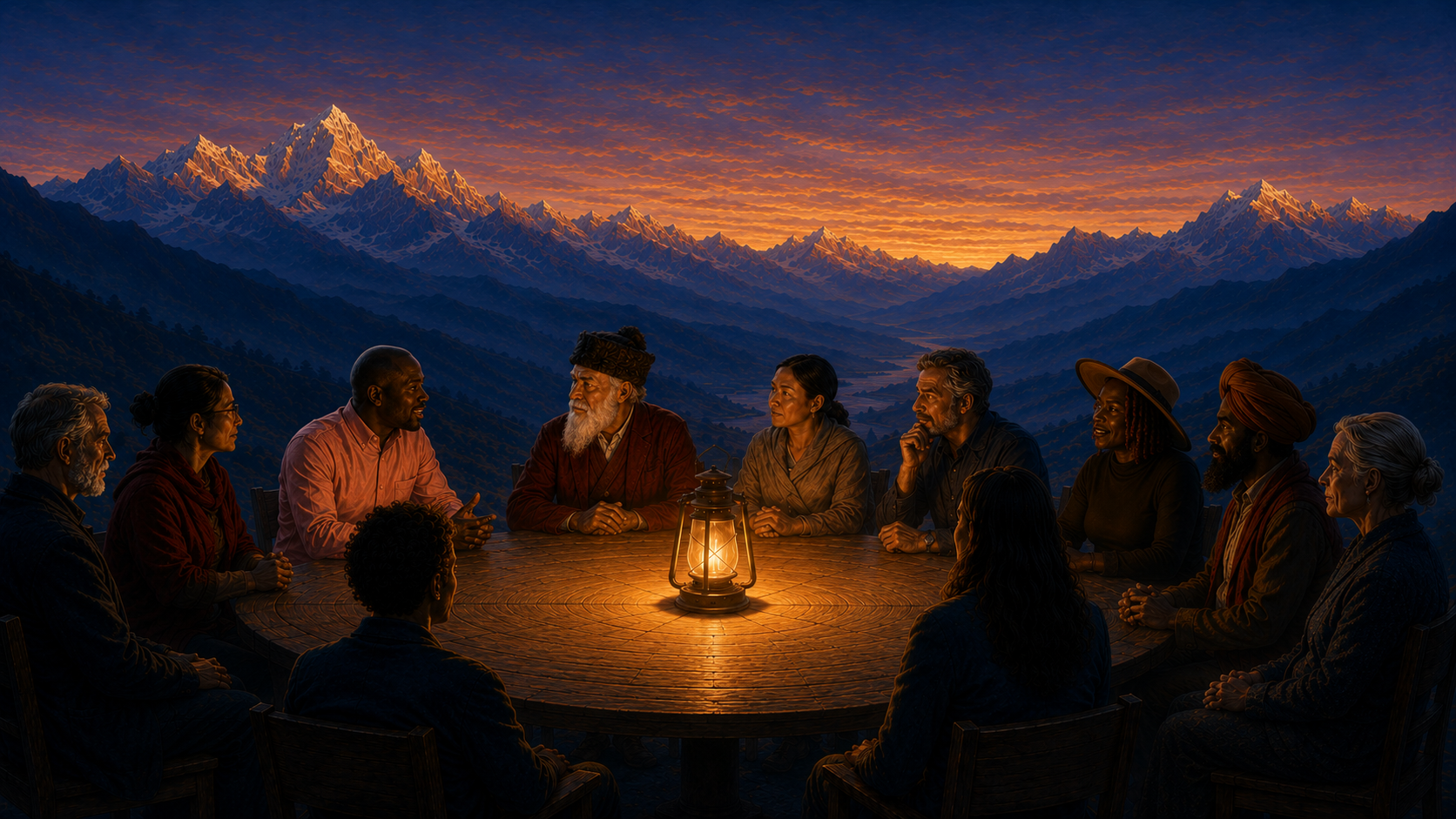
The Polymath Evenings explore ideas too large for a single discipline, in the company of some of the most brilliant minds of our time.
(And A.I. may be one of them).

Some questions can only be explored when scientists, poets, philosophers, historians, curators, and artists — together with observers of the inner life — meet around the same table.
The Polymath Evenings are a public conversation series created by L’Atelier Révolution to make those encounters happen.
Restoring the wholeness of knowledge
Science has long enjoyed something the arts have quietly lost: a living peer culture — a community of practitioners who hold one another to shared standards, argue in good faith, and build knowledge across generations.
The Polymath Evenings exist to cultivate that same culture in poetry and art — rigorous, generous, rooted in craft and history, and unafraid of beauty. Not art placed beneath science, but art restored to its rightful place within a single, whole way of knowing.
The model: an artist-poet meets a scientist who crosses boundaries
Each Evening begins with a conversation between two people — an artist-poet and a scientist whose work extends far beyond its discipline.
For forty-five minutes, they think aloud together: where a mathematical idea meets a poetic one, where the inner life meets the measurable, where beauty meets knowledge. Then the circle opens, and a small gathering of invited minds — a poet, a philosopher, a curator or museum professional — joins the conversation.
Rather than a conference or a panel, each Evening is an intellectual exploration where different ways of knowing illuminate one another.
Why “Polymath”?
Throughout history, humanity’s most influential thinkers refused to separate art from science, philosophy from practice, the inner life from action, or beauty from knowledge.
Leonardo da Vinci, Rabindranath Tagore, Nicholas Roerich, Johann Wolfgang von Goethe, and many others embodied this broader understanding of culture.
The Polymath Evenings continue that tradition — not by celebrating genius, but by rebuilding the dialogue across disciplines that made such genius possible.
The inaugural ONLINE edition
The first Evening brings Loïc Yengo — Snow Fellow, mathematician, geneticist, and musician — into conversation with poet and editorial director Murielle Mobengo.
Their subject: the origin of creativity — where mathematics, poetry-art, and the inner life meet, and what it would mean for the arts to reclaim the living peer culture that science has never lost.
Together, they open the conversation, joined by a circle of poets, artists, philosophers, scientists, and cultural thinkers, each illuminating the question from a different horizon.
Meet the Polymath Evenings Circle
A Living Format
Each edition is developed in partnership with a host institution.
Depending on the subject, the conversation may gather museum professionals, collectors, historians, philosophers, writers and storytellers, educators, and cultural leaders.
Every gathering is unique. Some begin with a work of art. Others begin with a question. All aim to leave everyone in the room with a richer way of seeing.
Hosted by Revue Révolution
The Polymath Evenings form part of L’Atelier Révolution, an institutional practice dedicated to exhibition storytelling, cultural strategy, and public programming.
By connecting art collections, philosophy, and scientific communities, the program seeks to create lasting cultural value, a polymathic legacy beyond the Event itself.
Current Development
The inaugural Polymath Evenings are currently in development in New York and Brisbane, Australia. The first public edition will be preceded by a series of digital conversations introducing the project’s themes and participants.
Institutions interested in hosting a future edition are warmly invited to get in touch.
Contact: polymathevenings@revuerevolution.com
A conversation series dedicated to beauty,
and the transmission of knowledge
where poet-artists, scientists, philosophers and observers of the inner life
meet.

L’Atelier Révolution — Exhibition Storytelling • Cultural Strategy • Public Programming