
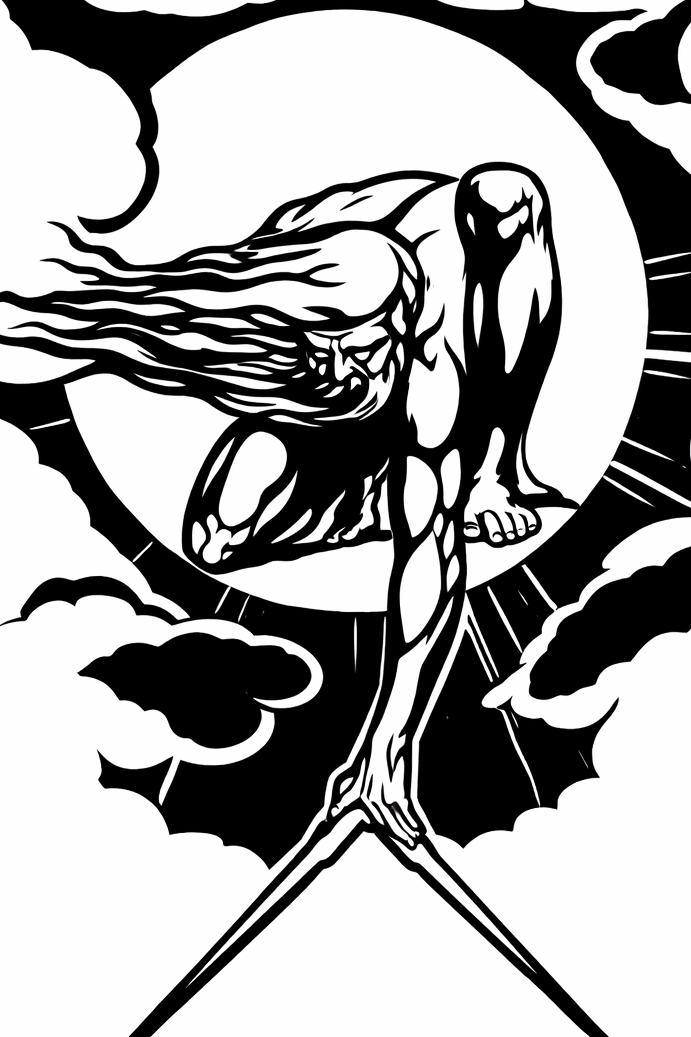
This article was originally published on our editorial blog in October 2020. We are re-presenting it here as part of our foundational archive because its core inquiry speaks directly to questions at the heart of cultural transmission: How do works of art acquire meaning across languages and cultures? What is lost—and what is gained—when we translate vision into interpretation? And what is the nature of the creative force itself, before any label is applied?
These questions are the daily work of curators, translators, and cultural stewards. The following reflection on William Blake’s The Ancient of Days offers a lens through which to examine them.


« The Globe shook, and Urizen, seated
On black clouds, his sore wound anointed;
The ointment flow’d down on the void
Mixed with blood: here the snake gets her poison »
William Blake,
The Book of Ahania, Chapter III, I (1795)
The Grand Architecte and the Question of Translation
William Blake’s The Ancient of Days is one of the most reproduced images in Western art. A muscular, bearded figure kneels within a blazing sun, reaching down with a compass to measure the darkness below. Blake himself called this figure Urizen—one of his mythological beings, a complex character who embodies reason, law, and limitation, but also the creative impulse gone rigid.
In France, the image carries a different title: Le Grand Architecte.
This seemingly neutral translation evokes the Enlightenment’s “Great Watchmaker”—a rational, orderly creator who designs the universe like a clock. It conjures Freemasonry’s “Great Architect of the Universe,” imposing a philosophical framework on an image born of an entirely different imagination: Blake’s own visionary, mythological, intensely personal cosmos.
Italians say traduttore, traditore—translator, traitor. But a mentor once told me: translation is re-creation. Beyond the acquiesced betrayal, another risk is superimposition. The translator, like the critic, like the curator, always brings their own world to the work they handle. The question is whether they are aware of it.
Urizen, Reason Without Poetry
Why does this matter? Because Blake’s Urizen is not the benign creator the French title suggests. In Blake’s mythology, Urizen represents reason separated from imagination, law divorced from vision. He is the figure who says: “One command, one joy, one desire, / One curse, one weight, one measure / One King, one God, one Law.”
Reason without poetry. Matter without spirit. Inertia, ultimate confusion, and bondage.
The French translation, however well-intentioned, erases this complexity. It replaces a paradoxical, ambivalent deity with a reassuring one. It makes Blake safe, rational, French—when Blake was none of those things.
Every cultural institution faces this tension. How do you present a work to a public that comes with its own assumptions, its own language, its own need for coherence? How do you mediate without distorting? How do you translate without betraying?
The Impersonal Force of Creativity
Blake was not merely an artist. He was a poet, a painter, a mythologist, a mystic, an inventor of printing techniques. He moved within genres, working from a source that preceded genre.
This is the nature of creativity at its deepest level. It is an impersonal force. It moves through the artist, but it does not belong to them. The artist’s task is to become a clear channel—to travel inward to the realm of ideas, and outward to the realm of expression, in an endless, disciplined movement.
The results of this movement—paintings, poems, myths—are what we call culture. They are equivocal: both intimate and extimate, private and public, born of the artist’s inner world and delivered into ours.
Once a work enters the world, it becomes available for two kinds of response: contemplation or desire.
Contemplation turns us inward. It invites silence, reflection, the quiet work of meeting the work on its own terms. Desire wants to possess. It grabs at the work with intellect, with sensation, with money. It turns the living into the useful, the mysterious into the manageable.
The non-creator’s anxiety is this: faced with something they did not make, something that exceeds their own imaginative reach, they seek to compensate. They analyze, they label, they interpret, they buy. They turn the creative act into data they can control.
The Curator’s Choice
Every curator, every translator, every cultural steward faces this choice. Will you stand in the mode of contemplation or desire? Will you present the work in a way that invites viewers to meet it—or in a way that masters it for them, explains it away, makes it safe?
The French title Le Grand Architecte is not inaccurate. It is just incomplete. It chose one meaning and erased the others. It made Blake legible to a rationalist culture, but at the cost of his mystery.
The alternative is not to refuse translation but to translate with awareness—to acknowledge what is being added, what is being lost, and to leave the work room to breathe.
This is the Non-Dual Gaze in practice: the effort to hold multiple meanings without forcing them into false unity. To perceive the work as both material and metaphysical, historical and timeless, the artist’s vision and the viewer’s encounter.
For Further Inquiry
At L’Atelier Révolution, we develop frameworks to help cultural institutions navigate these questions. How do you present works across cultural boundaries without distortion? How do you cultivate contemplative attention in a culture of consumption? How do you honor the impersonal force of creativity in your curatorial practice?
These inquiries are the daily work of anyone who handles the gifts and challenges of human imagination.
For institutional inquiries: institutions@revuerevolution.com
Murielle Mobengo is the founder and editor-in-chief of Revue Révolution. Her work explores the intersections of art, poetry, mythology, and non-dual philosophy. As Ellébore Guimon, she has developed a practice she calls neo-sacred portraiture: an artistic translation that moves from the realistic, rational, and dramatic inspirations of the Renaissance to the visual poetry of Kerala Mural Painting, a living tradition of spiritual art from southwestern India.
Leave a Reply