The Early Twentieth-Century Artist Who Speaks to Our Age
Why does Nicholas Roerich remain relatively absent from major conversations on contemporary art, while his work seems to address our moment so directly?
Painter of the Himalayas, explorer, thinker, educator, defender of cultural heritage, and creator of a language of peace through culture, Roerich was far more than a singular artist: he was a figure of synthesis.
In an age increasingly shaped by specialization, he reunited what modernity had separated: art and knowledge, contemplation and action, East and West, inner life and public responsibility. In that sense, he appears less as a figure of the past than as a possibility for the future.
To rediscover him today is not only to restore a remarkable legacy. It is to reopen an essential question: what becomes possible when creativity, depth of consciousness, and the common good act together?
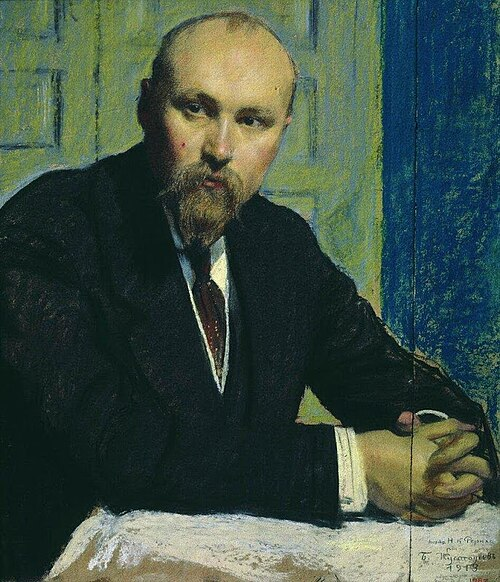
Featured image: Polymath Nicholas Roerich (1874-1947) by Russian painter Boris Kustodiev. Source: WikiGallery.
I. The Return of the Polymath
Western cultural history has often imagined the Renaissance as the golden age of complete human beings. Leonardo da Vinci remains its emblematic figure: painter, engineer, anatomist, inventor, thinker of form and life itself. Gradually, however, this figure seems to dissolve. The following centuries privileged specialization, sector expertise, and the methodical division of knowledge.
The modern world gained in precision what it sometimes lost in breadth.

To explore the deeper harmony beneath humanity’s cultural history, see Revue R’s timeline of consciousness expressed through poetry, art, and philosophy.
Nicholas Roerich appears within this landscape—not as the nostalgic repetition of an older model, but as the unexpected return of a human possibility thought to be fading: the ability to inhabit several fields of reality with coherence, rigor, and elegance.
Roerich was at once a major painter, writer, archaeologist, lawyer, stage designer, explorer, patron, educator, thinker of culture, and diplomat. Yet the list of his activities does not fully explain what makes him singular. Polymathy is not the accumulation of skills, but the harmonious and unifying perception of knowledge, sustained by inner discipline.
In him, disciplines do not merely coexist: they converse. Painting illuminates thought. Exploration deepens perception. Inner revelation informs both existence and public action. For Roerich, culture was not one social activity among many, but a principle capable of ordering harmony within human societies.
Perhaps this is why Roerich becomes more legible—and more essential—to us today.
Our age enters a fertile contradiction: never has knowledge been so specialized, and never has the need to reconnect it been so urgent. Amid crises of meaning, institutional fragmentation, and the separation of technology, art, ecology, inwardness, and politics, the need re-emerges for minds capable of bringing worlds into dialogue.
Roerich belongs not only to history. He belongs to a contemporary question that every cultural institution, and every actor within the cultural ecosystem, must face: how might we become whole again?
Polymathy is not the accumulation of skills, but the harmonious and unifying perception of knowledge, sustained by inner discipline.
Revue Révolution, A Review Of Cultural Diplomacy
Issue # 7 – “Many Returns: The Non-Dual Gaze, Re-Emergence Of A Perennial Curatorial Practice
II. Travel as a Mode of Knowledge
Some works are born in the silence of the studio. Others require the road, altitude, crossing, climate, and encounter with the unknown. The life and great work of Nicholas Roerich testify to this second necessity.
From Russia to Europe, through America, then India, and onward to the vertiginous plains and peaks of the Himalayas, Roerich moved through worlds with a rare intuition. The East would naturally occupy a distinct place in this quest: a distant horizon — golden, saffron, alive with metaphysics, refined cosmologies, inner disciplines, and arts oriented toward elevation.
At this point, a familiar suspicion of our age may arise: orientalism, exoticism, cultural appropriation.
A clarification is needed.
Within the creative impulse, the desire for other worlds—and other selves—may also arise from the recognition of beauty, from the urgent desire to learn, from humility before what is admirable, from a sincere wish to honor what shines beyond one’s familiar frame.
As Arthur Rimbaud once wrote: I is an other.
Art history is woven with such encounters. From ancient exchanges between Mediterranean and Asian worlds, to symbolic cross-pollinations across centuries, from the Pre-Raphaelites to Eugène Delacroix, cultures have often fertilized one another through admiration, translation, and symbolic hospitality.
It was in this spirit that Roerich undertook his major Asian expeditions between 1925 and 1929, and later journeys toward Mongolia and Manchuria. He did not seek landscapes alone, but moved toward a dream, a vision, a terrestrial singularity known under many names in the subtle wisdom traditions of the world: Shambhala.
A legendary place in Central Asian Buddhist traditions, Shambhala is also the memory of a higher order: a city of wisdom, an inner civilization, a geography of fulfillment.
Across civilizations, this intuition reappears under different names: Atlantis, Lemuria, Kumari Kandam, lost golden ages, heavenly kingdoms. Everywhere returns the same longing for a reconciled world where knowledge, beauty, science, nature, and consciousness are no longer divided.
Roerich’s work, no less than his travels, became a cartography of that longing.
America also occupies an essential place in this trajectory. Invited to the United States in the early 1920s, Roerich discovered far more than a new audience. In the American Southwest, particularly in Santa Fe, his encounter with Edgar Lee Hewett marked a decisive turning point.
Among Pueblo peoples and Indigenous traditions of the continent, he perceived deep correspondences with ancient inheritances of Russia and Asia. He encountered visions of the world in which beauty, sacred place, ritual, architecture, and daily life still formed an organic unity.
This meeting confirmed one of his central intuitions: humanity may have many sources, but only one depth.
The more Roerich crossed worlds, the more he discovered what binds them together.
Our age enters a fertile contradiction: never has knowledge been so specialized, and never has the need to reconnect it been so urgent. Amid crises of meaning, institutional fragmentation, and the separation of technology, art, ecology, inwardness, and politics, the need re-emerges for minds capable of bringing worlds into dialogue.
Revue Révolution, A Review Of Cultural Diplomacy
Issue # 7 – “Many Returns: The Non-Dual Gaze, Re-Emergence Of A Perennial Curatorial Practice
III. Art as the Manifestation of Intuitive Knowledge
At the heart of certain works there is a quality of presence that exceeds technical virtuosity alone. Craft matters, of course. Yet it does not fully explain why certain images remain within us, act upon our sensibility, or seem to contain more than they visibly show.
Across civilizations, many traditions recognized forms of knowledge that do not arise solely from discursive reasoning or the accumulation of information.
The philosophy of yoga gives one of the clearest names to this faculty: pratibhā-jñāna—intuitive knowledge. Not vague intuition, but a clarified intelligence capable of grasping causes, effects, and relations before they are fully formed.
In this light, Roerich’s path appears newly coherent.
His journeys through India, Tibet, Central Asia, and the Himalayas suggest more than scholarly curiosity or adventure. They belong to landscapes long associated with contemplation, transformation, and expanded perception.
With his wife Helena Roerich, he developed Agni Yoga: an ethical and symbolic path seeking to unite Western inheritances, yogic traditions, inner life, creativity, and public responsibility.
Yet the clearest measure of this vision lies in the forms it produced: the same intelligence is visible on canvas.
Roerich’s art is marked by formal clarity. Lines are simplified, masses firmly composed, silhouettes reduced to essential necessity. Mountains become architectures of force rather than naturalistic detail. Roads, monasteries, riders, and distant cities appear with symbolic precision.
In this sense, his work enters into dialogue with several twentieth-century modern movements—futurism, cubism, geometric abstraction, orphism—which also simplified form in search of greater evocative power. Yet where some avant-gardes pursued rupture for its own sake, Roerich pursued another path: simplification in the service of elevation.
Color forms the other major dimension of his pictorial language. Working in tempera and oil, he created matte luminous surfaces where color seems to radiate from within. Deep blues, radiant reds, quiet golds, threshold violets, tender whites filled with light: color does not fill the form, it reveals it.
Today, when so many images saturate attention without leaving a trace, Roerich reminds us that an image can still orient, unify, calm, and elevate. One may be modern without abandoning depth, contemporary without yielding to cynicism, innovative without renouncing beauty.
In Roerich, art becomes visible knowledge.
IV. Banner of Peace: Cultural Diplomacy Before Its Time


From left to right: Nicholas Roerich with Jawaharlal Nehru in India, c. 1942 • Representatives of 21 American nations sign the Roerich Pact at the White House, with Franklin D. Roosevelt, 15 April 1935 • The symbol of the Banner of Peace beside the United Nations emblem on a Mexican stamp.
Where many artists were forced to choose between aesthetic withdrawal and public engagement, Roerich attempted another path: making culture itself an active principle of peace.
This intuition took institutional form in the Roerich Pact, signed in Washington in 1935 by the states of the Pan-American Union. It affirmed that cultural, educational, scientific, and artistic institutions should be protected under all circumstances, including war.
The idea was simple and powerful: what is highest in human civilization must not become collateral damage.
To this legal vision Roerich added a symbol: the Banner of Peace, three spheres enclosed within a circle. Interpreted in multiple ways—art, science, and spirituality; past, present, and future; humanity united in wholeness—it possesses the rare force of an open symbol: it speaks at several levels without exhausting itself in one definition.
Long before the language of “soft power” or cultural diplomacy became common, Roerich understood the civilizational power of artworks, monuments, archives, and places of transmission.
When culture is destroyed—through war, ideology, neglect, or ignorance—a society loses more than objects. It loses continuity, memory, and part of its future.
That insight has lost none of its urgency.
The twenty-first century continues to aestheticize violence while threatening what elevates us. In this context, Roerich’s question remains fully alive: how do we protect what makes us more human?
Our time may need to go further still: not only to preserve works of culture, but to relearn how to see what they teach.
Murielle Mobengo
NICHOLAS ROERICH MUSEUM, NEW YORK
THE Polymath CURATOR
Enter one of our most fascinating conversations on art, the creative fire, cultural memory, and Native American art with Dmitry Popov, Chief Curator of the Nicholas Roerich Museum, New York.

GENIUS ETC.
4 foundational readings on beauty, genius, and the polymathic mind — exploring how greatness appears, how it is recognized, and why it remains rare.
