
We’re in this together.
This is bigger than us.
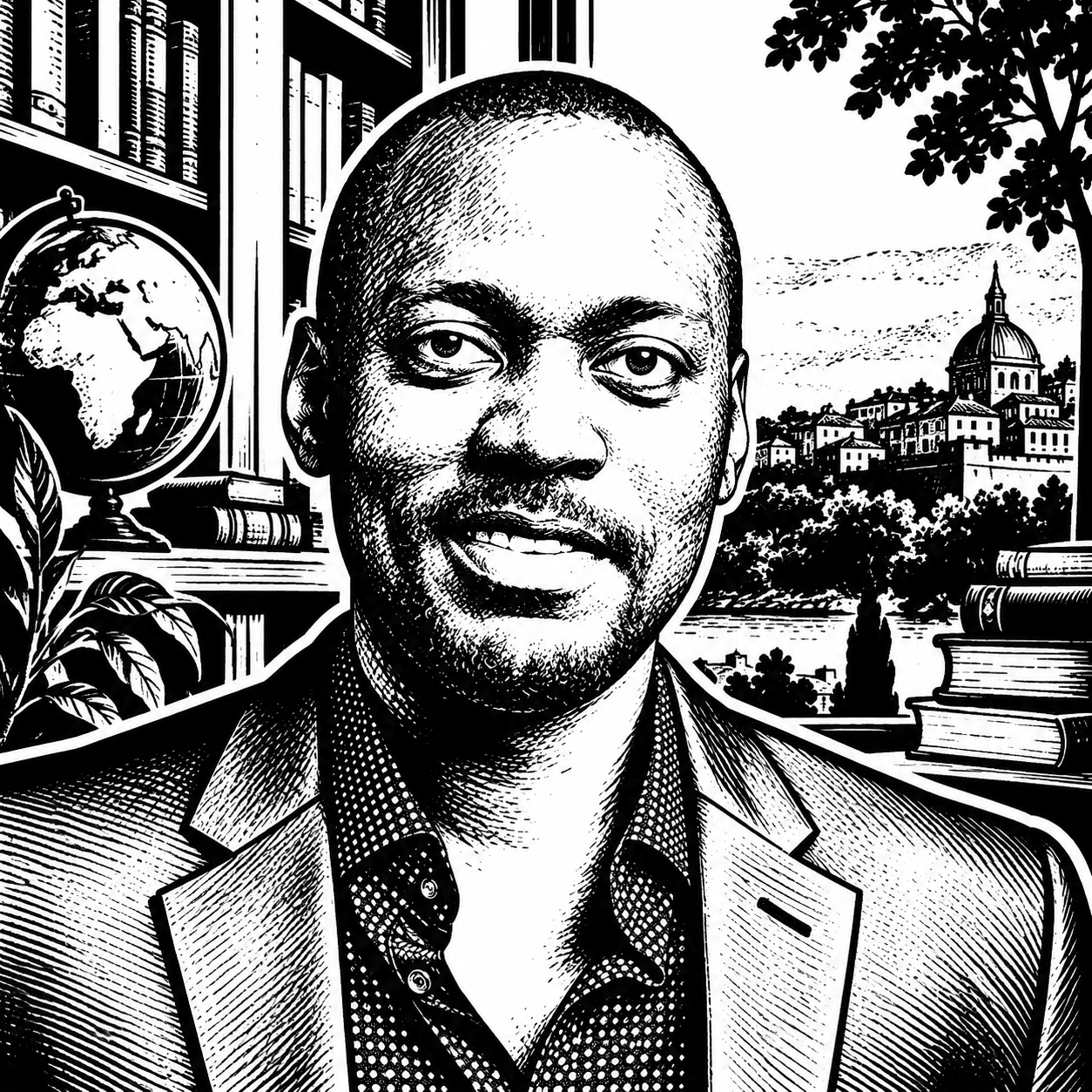
–Loïc Yengo on scientific culture
V. What Is the Technology of Poetry?
Loïc Yengo: There’s another way I think science might help us ask the question.
In science, we build technologies in order to perceive things that we suspected were there but couldn’t observe before.
In my own field, for example, it’s only relatively recently that we’ve been able to sequence the entire human genome. We built technologies because we thought there was something there to observe.
And those technologies change what science is capable of knowing.
Without the tools we have today, there are things we simply couldn’t observe. If you can’t observe the brain with an MRI, for example, you might look at someone’s skull and draw all kinds of insane conclusions from its shape.
Now we have better observational tools.
So if poetry and the arts have a different object of observation, what are their observational tools?
Can those tools be improved? Can they be augmented?
Murielle: That’s a fantastic question.
Sourav once said to me, “We don’t have much. We only have perception.”
And perhaps language itself can be understood as a technology of perception. But there are other tools — they’re simply not usually identified as such.
If we ask what poets have been observing since the dawn of humanity, I would say: the self.
Even when the poet appears to be observing the world outside, the poet is also observing the self experiencing that world.
And the expression of that experience conveys a quality. It’s very subtle — a quality of consciousness — which can then be transmitted through the poem.
So I would say introspection is a technology of poetry.
Loïc: Meditation.
Forms of meditation.
Murielle: Absolutely. Meditation is perhaps one of the most powerful tools available to the poet because it allows you to observe the observer.
And that’s an extraordinarily difficult position to occupy when you’re trying to extract knowledge or significance from the world.
Why meditate, after all?
You close your eyes. Perhaps you use a mantra. You observe thoughts arising. Why would anyone do that if not, in some sense, to observe the self — to observe the observer?
So yes: introspection and meditation are tools of observation.
Loïc: And conversation too.
Conversation is a very powerful observational tool because it gives you some insight into what may be happening in another self. And sometimes another person can mirror a part of yourself that you can’t quite observe directly.
Murielle: Which is rather appropriate for what we’re doing right now.
Loïc: Exactly.
But then there’s another question. Science doesn’t only have tools for observing. It also has ways of determining whether those observations are leading somewhere.
So once poets begin observing the observer, how do you know whether you’re on the right track?
Murielle: That’s the problem.
Science has protocols. What would constitute a protocol for poetry?
Murielle: Earlier, when you asked what poetry is trying to describe, I answered: inner experience.
Poetry is the expression of the self experiencing existence.
My own understanding is deeply informed by Advaita Vedanta, where consciousness isn’t ultimately divided into separate selves. I sometimes picture consciousness as a pot containing all our apparently separate experiences.
And perhaps poetry isn’t merely describing the individual selves inside the pot.
Perhaps poetry is trying to describe the pot.
Of course language begins to fail there. Words escape us. That’s partly why poetry can seem cryptic. You sense that something is being communicated without necessarily being able to decode it.
It’s rather like what you said about mathematics: you need some degree of code in order to read it.
Except the code of poetry is hidden within consciousness, human experience and language.
So perhaps philosophy is a tool of poetry. Perhaps poetry is a technology of philosophy.
And philosophy itself may be a technology of consciousness.
Loïc: I was already out of my depth after level two.
Murielle: [Laughs.] And then the terrible question becomes: what is consciousness the technology of?
Loïc: That’s where something doesn’t quite sit well with me.
Because everything I’ve said about technology assumes a distinction between an observer and a world outside the observer. Technology sits somewhere in that relationship: I am here, something is there, and I build a tool that allows me to observe it.
But when we arrive at consciousness, I’m no longer sure there is an inside and an outside in the same way.
So asking whether consciousness is a technology may actually expose the limit of the analogy.
Murielle: Which is interesting in itself.
Because perhaps we’ve followed the metaphor as far as it can take us.
Leave a Reply