
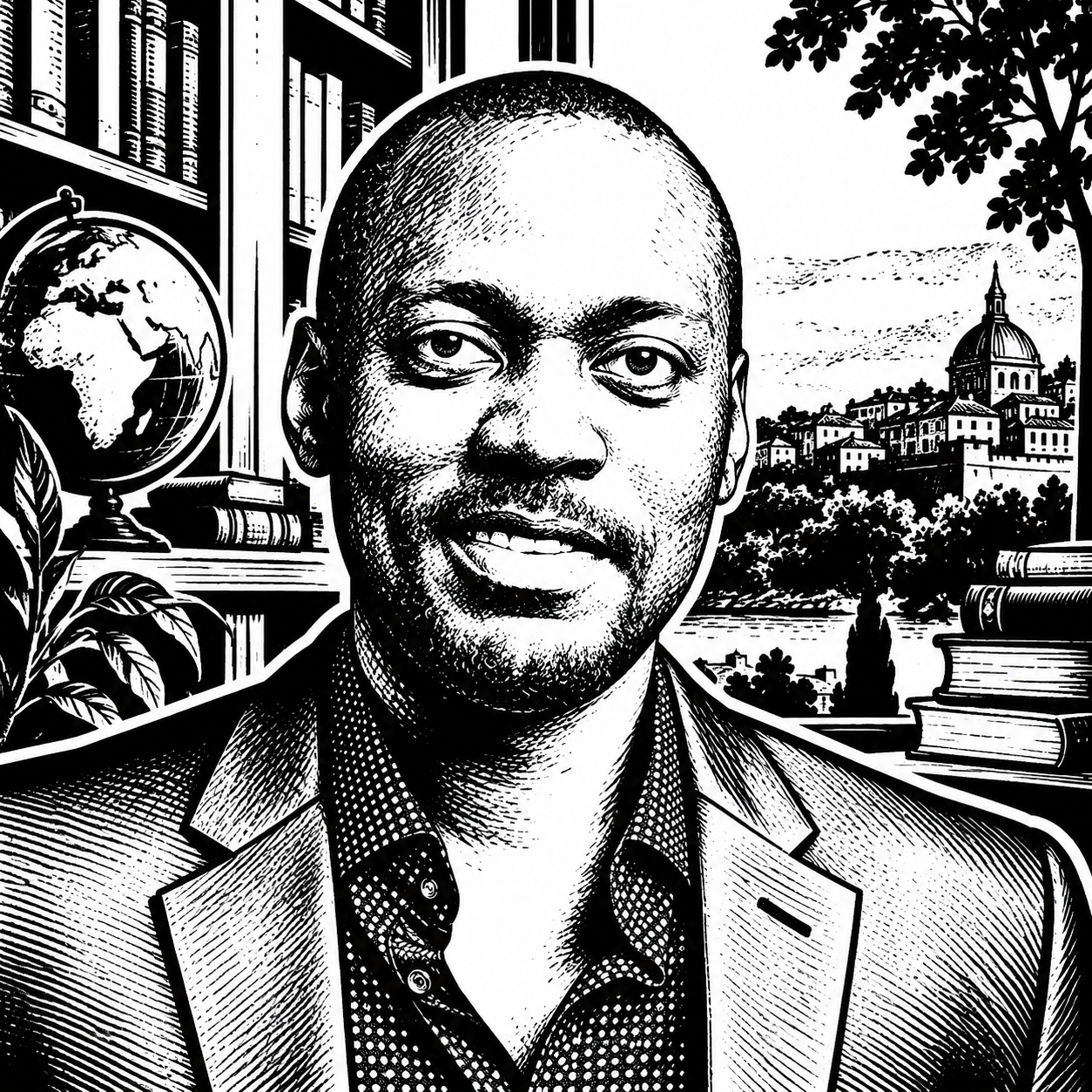
X. Mythology Is Poetry in Raw Form
Murielle Mobengo: This makes me think about mythology.
Because mythology is another form capable of carrying an extraordinary amount of information.
And I sometimes think of mythology as poetry in raw form.
Loïc Yengo: Yes. And storytelling is an incredibly powerful way of conveying complex knowledge.
If you think about societies where knowledge is transmitted orally, you need ways of preserving information across generations.
You can’t simply hand someone a technical document.
You need forms that people can remember, repeat and transmit.
Murielle: Which is where the storyteller comes in.
I grew up partly in Africa, and this makes me think of the griot.
The griot isn’t simply entertaining people. The storyteller can be carrying history, genealogy, memory, values, explanations of the world — different kinds of knowledge simultaneously.
Loïc: Exactly.
And that’s why I wouldn’t oppose mythology and knowledge too quickly.
A story can convey something extremely complex to someone who doesn’t have the technical vocabulary required to receive the same knowledge in another form.
We do something similar in science.
When scientists communicate with the general public, we use stories. We use metaphors. We simplify things. We construct a narrative through which someone can understand the important structure of an idea without necessarily understanding all the technical details.
Murielle: So mythology could be understood as a technology of transmission.
Loïc: Yes.
And perhaps the interesting question isn’t simply whether the story is factually true in every detail.
The question is: what is the story trying to convey?
What knowledge is being preserved through it?
Murielle: That’s important, because modernity has created this rather brutal opposition between myth and fact.
If something is a myth, we tend to mean that it isn’t true.
But historically, myth doesn’t function that way.
A myth may contain historical memory, cosmology, ethics, metaphysics, observations of nature — and all of those things can be woven into a story that can survive for centuries.
Loïc: And the survival itself is interesting.
Because if we’re talking about transmission, then mythology is obviously very successful.
People remember stories.
They repeat them.
They modify them, perhaps, but the structure can persist across enormous periods of time.
Murielle: Which brings us back to poetry.
Meter, rhyme, narrative, image — these aren’t merely aesthetic embellishments.
They can be technologies of memory.
Loïc: Yes.
And perhaps that is something modern forms of knowledge sometimes underestimate.
We can store almost infinite amounts of information now. We don’t need to remember everything because we have books, computers, databases.
But storing information isn’t the same thing as integrating knowledge into a culture.
Murielle: Oh, that’s a very important distinction.
A database can preserve information.
But that doesn’t mean anybody carries it.
Loïc: Exactly.
Murielle: But mythology introduces another element that we haven’t really discussed: belief.
For a myth to operate within a culture, perhaps people don’t have to believe every element literally, but there has to be some relationship between the story and what the culture considers real.
Loïc: Yes.
And science has belief too.
Not necessarily belief in the same sense, but scientists operate with assumptions.
We believe that the world can be observed. We believe that our observations can tell us something about it. We believe that if someone performs an experiment under sufficiently similar conditions, something comparable should happen.
Those beliefs are built into the enterprise.
Murielle: So perhaps belief isn’t necessarily the opposite of knowledge.
Loïc: No.
The problem is what happens to belief when evidence challenges it.
Science has developed protocols for that.
Ideally, you modify the model.
Of course scientists are human beings, so sometimes they become attached to their models.
Murielle: Heresy!
Loïc: [Laughs.] It happens.
But the structure of science at least says that the observation has priority.
Murielle: Whereas mythology may be doing something different.
It may not be asking you to test whether Krishna actually stood at a particular place and performed a particular action in exactly the way a story describes it.
The story may be carrying another kind of knowledge.
Loïc: Yes.
And then the question becomes: how do you evaluate that knowledge?
We’re back to epistemology.
Murielle: Again.
[Laughter.]
Loïc: Everything comes back.
Murielle: I don’t think the point is to say that every myth contains a scientific fact waiting to be decoded.
That would simply make science the final authority on mythology.
What interests me is that human beings have developed different forms for carrying different dimensions of knowledge.
A scientific paper does something extraordinarily well.
An equation does something extraordinarily well.
And perhaps a myth does something extraordinarily well that neither of those forms can do.
Loïc: I agree.
If you’re trying to communicate something very complex — especially something involving several levels at once — storytelling may actually be more efficient.
You can embed relationships in a story without having to explain each one explicitly.
And different people may understand different levels of it.
Murielle: Which sounds remarkably like poetry.
Loïc: It does.
Murielle: Hence: mythology is poetry in raw form.
Loïc: We’ve come back to your original statement.
Murielle: We’re very circular today.
[Laughter.]
Murielle: Maybe all of these disciplines are doing something related.
Science builds languages through which we can describe observations.
Mathematics compresses relationships into symbolic forms.
Poetry compresses experience into language.
Mythology carries complex structures through narrative.
Philosophy allows us to examine the concepts through which we understand what we’re experiencing.
They’re different — I don’t want to erase those differences — but perhaps they’re all ways of augmenting our capacity to perceive and transmit what we know.
Loïc: Yes.
And perhaps that’s why the separation between disciplines can become limiting.
Specialization is incredibly powerful. It allows you to go very deep.
But at some point, you may need other vocabularies to describe what you’ve reached.
Murielle: That’s almost what I mean by transcendence.
Not escaping the world.
Increasing the range of what can be perceived.
Loïc: Augmenting perception.
Murielle: Exactly.
Leave a Reply