
XI. Disciplines of Transcendence
Loïc Yengo: I think we’re coming full circle.
What you said about belief made me think again about myth. Earlier, when I asked what kind of technology could be derived from poetry, I actually had religion somewhere in mind.
Religion is an extraordinarily powerful technology in the sense that it can influence what people believe — and if you can influence what people believe, you can influence the world.
But there’s a question that obsesses me: how do you convey belief?
And I think science needs different mythologies too.
Science already has some of its own mythologies, but I find that they fall short for the kind of science that I think matters — science that bridges disciplines.
Because ultimately science is meant to describe the world, and the world is much bigger.
I think we need new myths within science that can convey this notion of transcendence.
We’re losing it.
And transcendence is a very powerful idea because once you have some sense of it, bridging fields or entering into dialogue with other disciplines comes naturally. You understand where you fit, and you realize that there are bigger things out there.
Murielle Mobengo: Transcendence.
That’s interesting, because perhaps we’re arriving at the final moments of this beautiful, eternal conversation.
Several years ago, I had a conversation with a group of poets about transcendence.
Some of them were essentially saying: What do we need transcendence for? We don’t need that anymore. Transcendence belongs to the old world. We’re the new.
And I wanted to make sure we actually understood what we were rejecting.
So I asked a very simple question:
What is transcendence?
Blank.
Absolute blank.
And I realized that we were refusing something we didn’t fully comprehend.
For poets, there’s a wonderful way out of that situation: etymology.
If you’re responsible for language, you have to be prepared to enter its uncharted territories.
A word may sound terribly academic or elitist because you’ve heard philosophers use it for a hundred pages. But you can go back to the word itself and ask what it’s actually carrying.
And that’s what I did with transcendence.
Trans- gives us the movement of crossing, of going across. And then there is this movement upward.
Suddenly transcendence isn’t this enormous, abstract intellectual concept anymore.
It’s something much simpler: being traversed by something that takes you beyond where you were.
You can apply that to science. You can apply it to poetry, art, your inner life, even to ordinary life.
And that makes me think that transcendence describes something fundamental about knowledge.
In fact, perhaps it’s an even better word than knowledge.
Loïc: Than knowledge.
Murielle: Perhaps we should speak about disciplines of transcendence.
Because isn’t that what disciplines do?
When you genuinely engage with knowledge, you don’t simply move sideways. Something happens to your perception. You are no longer exactly where you were before.
Loïc: I was just thinking that this moment might actually be what the whole conversation is about.
Murielle: It is.
Here we are.
Loïc: Disciplines of transcendence.
Murielle: That’s what we’re doing here.
Loïc: That’s beautiful.
Because of course we know things. We know all kinds of things.
But what’s exceptional about simply knowing?
For me, knowing is actually an activity of transcendence.
Knowledge happens within that movement.
And then perhaps we can make another connection with consciousness.
Does transcendence happen within consciousness?
Or is it the other way around?
Murielle: That’s a question for another time.
Loïc: That’s a question for another time.
Murielle: Or for the collective conversation we’re going to have together.
Loïc: Yes. Absolutely.
Murielle: Wow. My heart is full.
As I said at the beginning, I don’t think we’ve done this in a while.
Loïc: Not in this language.
Murielle: In this language, no.
Loïc: And interestingly, nothing has changed.
Murielle: Nothing changes.
Loïc: Thank you for inviting me to take part in this conversation.
And what you’re building around it is really important.
I’m grateful to be living at the same time as you are.
Murielle: Oh, God.
That’s a very transcendental thing to say to me.
Thank you.
And thank you for helping me contextualize what I’m trying to create — this project I have for poets and artists, this curriculum.
I can’t wait to discuss it with the other members of the Circle.
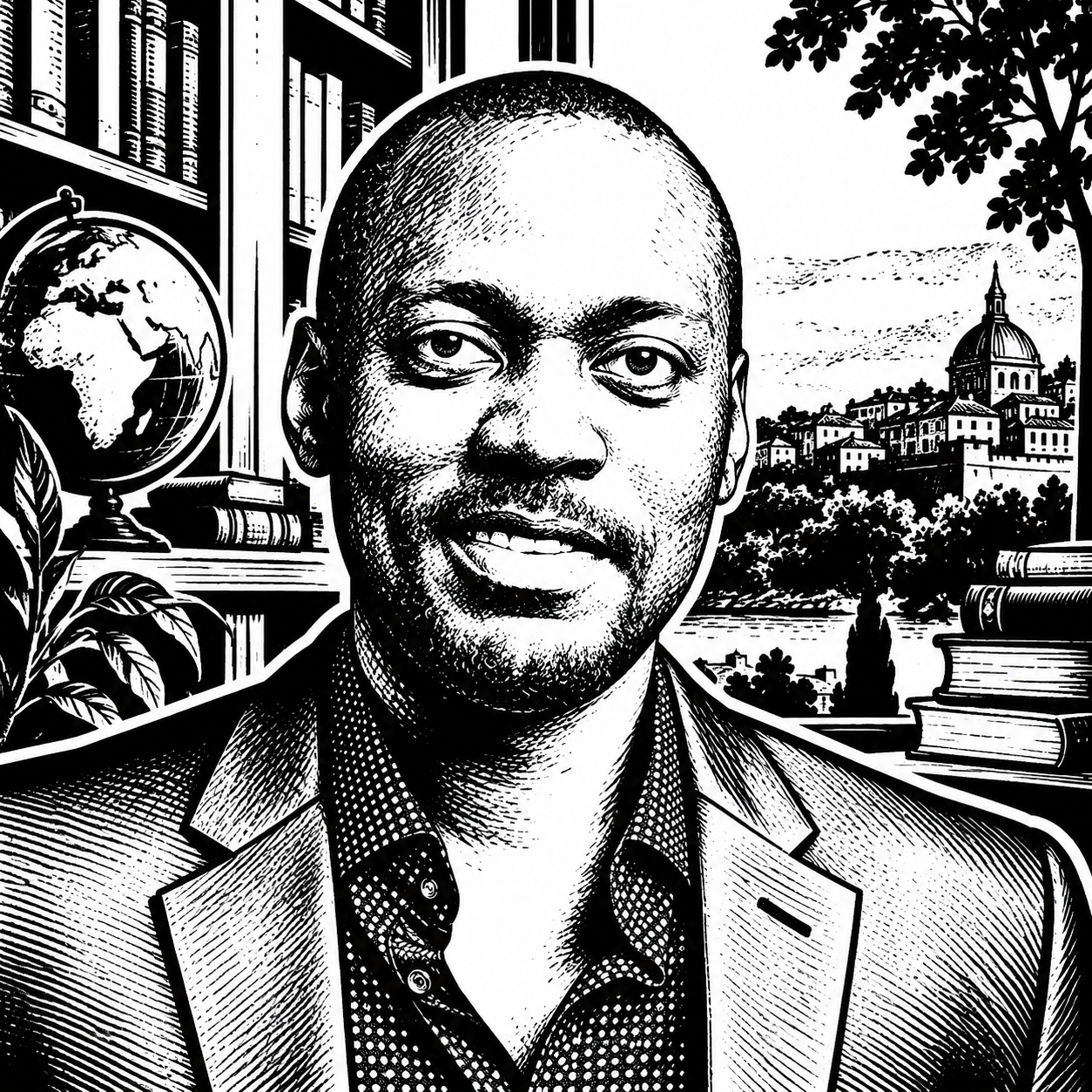
About Loïc Yengo

Loïc Yengo is a statistical geneticist whose research investigates the genetic architecture of complex human traits. His work brings together mathematics, statistics, genetics, and large-scale biological data. A musician as well as a scientist, his thinking moves across scientific and artistic forms of knowledge and the ways through which human beings observe, describe, and make sense of the world.
Polymath Evenings
About the Polymath Evenings
The Polymath Evenings are an experiment in collective inquiry initiated by Revue Révolution. Their broader purpose is to contribute to the creation of a living culture of peers for poetry and the arts, inspired by the collaborative cultures of the sciences.
Each Opus brings different forms of knowledge, experience, and perception into sustained dialogue around a shared problem. Opus I asks: What is the source of creativity?
This Polymath Portrait Conversation forms part of the preparation for the first collective gathering of the Polymath Circle.
Leave a Reply